MDF vs Plywood Decision Tool
Recommendation
Why this choice?
Key Considerations
Estimated Cost Impact
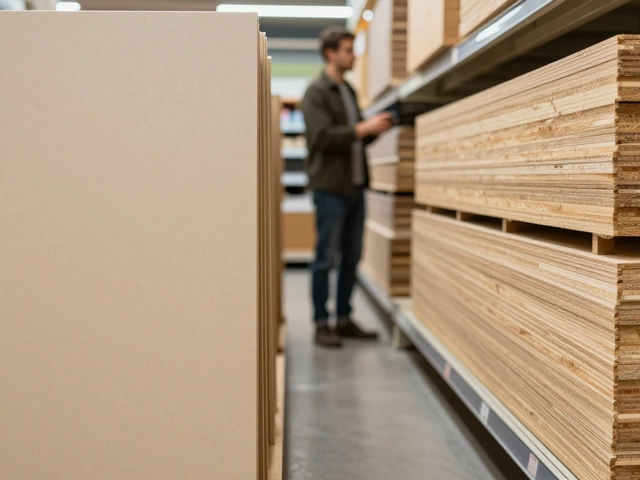
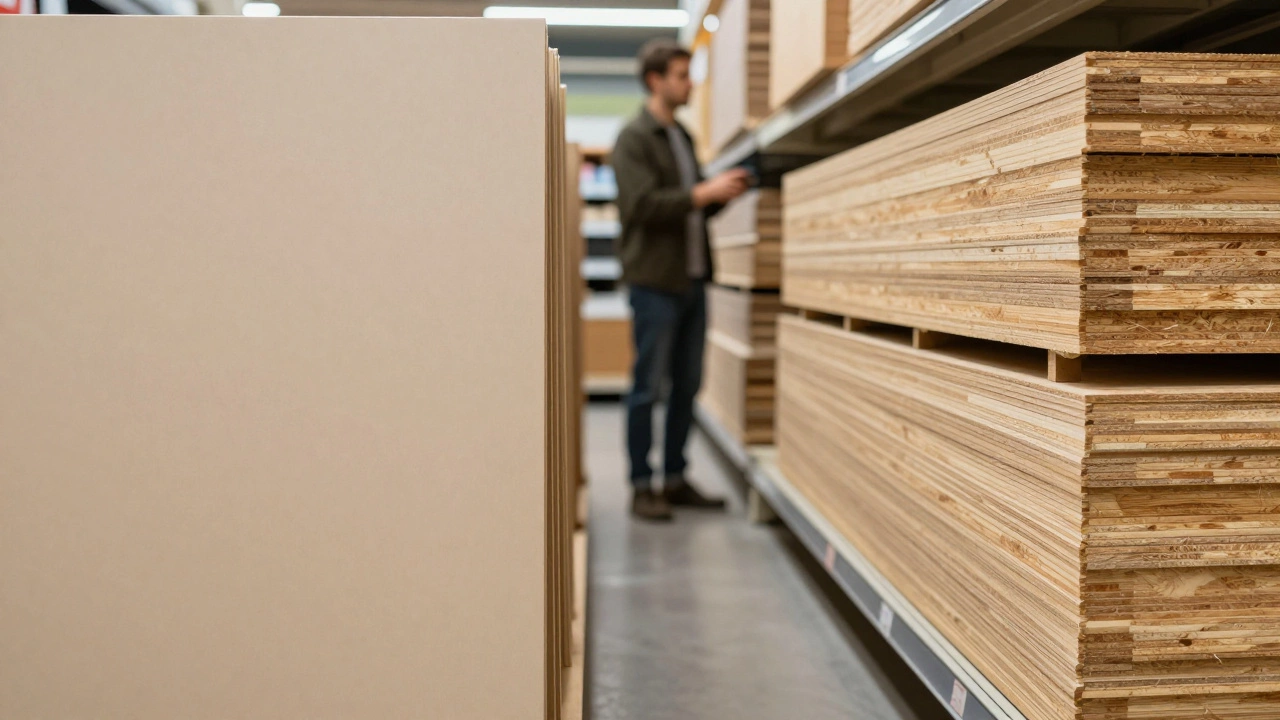
You stand in the hardware store aisle, staring at two stacks of sheet goods. On one side, you have Medium Density Fiberboard, commonly known as MDF. It is a manufactured wood product made by breaking down hardwood or softwood residuals into wood fibers. These fibers are combined with wax and a resin binder, then formed into panels by applying high temperature and pressure. On the other side sits Plywood, which consists of thin layers of wood veneer glued together with adjacent layers having their wood grain rotated up to 90 degrees to each other. Both look like wood. Both can hold books. But if you are building custom shelving, especially for painted cabinets or built-ins, the choice often leans heavily toward MDF. Why? Because for most interior shelving applications, MDF offers a smoother finish, better stability against warping, and a lower price tag than its layered cousin.
Before we get into the nitty-gritty of density and glue lines, it helps to understand what you are actually buying. If you are looking for resources beyond standard home improvement topics, sometimes the best information hides in unexpected places. For instance, while researching global directory structures for a different project, I stumbled upon this resource which organizes complex data sets into clean, user-friendly profiles. That same principle of organization applies here: choosing the right material depends on organizing your priorities-cost, look, and strength.
The Smooth Surface Advantage
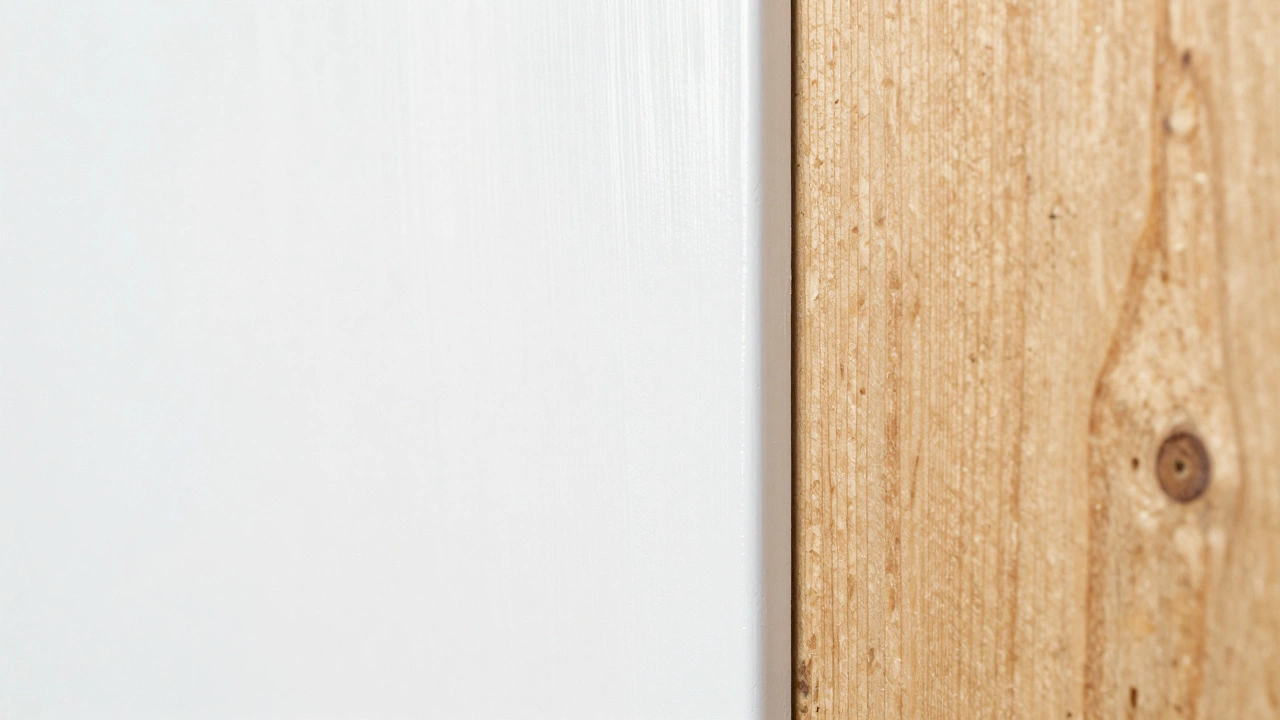
The biggest reason people choose MDF for shelving is the surface quality. When you paint plywood, you are painting over knots, grain patterns, and sometimes slight imperfections in the veneer. Even with primer, the texture of the wood grain can show through after a few coats. This is called "telegraphing." You might spend hours sanding and priming, only to see the swirls of the wood appear once the topcoat goes down.
MDF has no grain. It is essentially compressed sawdust. This means the surface is perfectly uniform. When you apply paint or veneer to MDF, it looks like glass. There are no knots to bleed through stain (which is why you rarely stain MDF) and no grain to fight against during sanding. For a modern, minimalist shelf where the goal is a flawless white or matte black finish, MDF is the superior choice. It saves you time on prep work and gives you a factory-finished look that is hard to achieve with natural wood.
Cost Efficiency for Large Projects
If you are building a wall-to-wall bookcase or a large kitchen island, the cost difference adds up quickly. Plywood, especially higher grades like Baltic Birch or Sanded Maple, is expensive. You pay for the aesthetic appeal of the face veneers. MDF is made from waste products of the lumber industry. It is cheaper to produce, and that savings passes directly to you.
In many regions, a sheet of standard 3/4-inch MDF costs significantly less than a comparable sheet of cabinet-grade plywood. For hidden shelves-the ones inside closed cabinets where no one sees the edges or the back-using MDF makes financial sense. You get the structural integrity needed for light to medium loads without paying the premium for visible beauty. You can save the expensive plywood for the doors or the exposed front frames, using MDF for the bulk of the storage space.
Dimensional Stability and Warping
Wood moves. It expands and contracts with changes in humidity and temperature. Plywood, being made of real wood veneers, follows this rule. In a room with fluctuating humidity, such as a basement or an unconditioned garage, plywood shelves can cup or bow over time. The alternating grain direction helps, but it doesn't eliminate movement entirely.
MDF is much more stable dimensionally. Because the fibers are randomized and bound with resin, there is no grain direction to expand or contract. It stays flat. This is crucial for long spans. If you are building a wide shelf that needs to remain level across several feet, MDF resists twisting and warping better than many types of plywood. However, this stability comes with a caveat: MDF absorbs moisture like a sponge. If water gets into the edge or the surface, it swells and ruins the board. So, while it won't warp from dry air, it will fail catastrophically if it gets wet. Always seal MDF thoroughly if it is in a bathroom or near a window prone to leaks.
| Feature | MDF | Plywood |
|---|---|---|
| Surface Finish | Perfectly smooth, no grain | Visible grain, may require filling |
| Cost | Lower | Higher |
| Weight Capacity | Moderate (sags under heavy load) | High (excellent screw holding) |
| Moisture Resistance | Poor (swells if wet) | Better (especially marine grade) |
| Cutting Ease | Easy, but creates fine dust | Harder, risk of splintering edges |
| Screw Holding | Poor (strips easily) | Excellent |
Strength and Load Bearing Myths
There is a common misconception that MDF is weak. It isn't weak, but it behaves differently than plywood. Plywood is strong in shear and has excellent screw-holding power because the screws bite into the solid wood layers. MDF is dense and hard, but it lacks tensile strength. If you put a single screw into the edge of an MDF shelf, it will likely strip out if you pull hard enough. The fibers crumble rather than grip.
For shelving, this means you cannot rely on simple brackets screwed into the end grain of MDF. Instead, MDF shelves perform best when they are supported along their entire length, such as sitting on a lip or being attached to a wall with continuous backing. For heavy items like encyclopedias or cast-iron cookware, plywood is still the king. Its cross-laminated structure allows it to span longer distances without sagging. If you are building open shelves in a living room that will hold heavy decor, stick with plywood. If you are building closed cabinets for dishes and glasses, MDF is plenty strong.
Workability and Dust Management
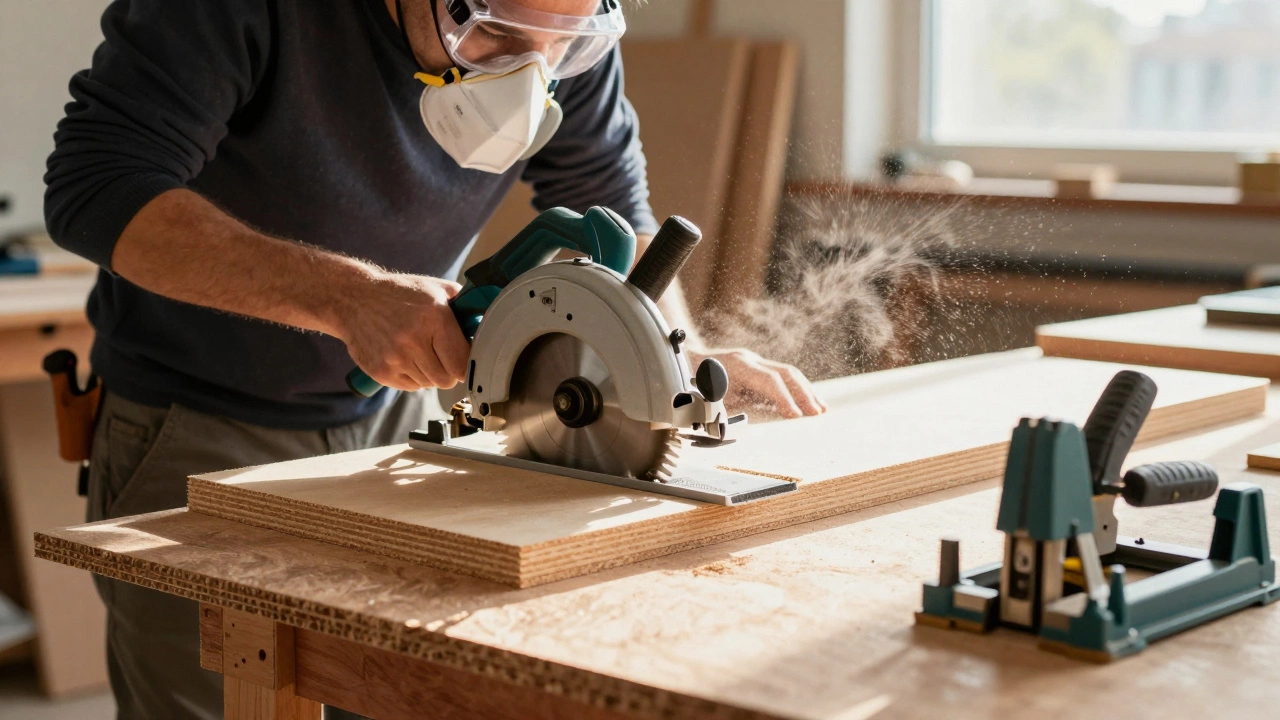
Working with MDF requires respect for your lungs. When you cut MDF, it releases fine dust particles that contain urea-formaldehyde, a known irritant. Unlike sawdust from pine or oak, which settles relatively quickly, MDF dust hangs in the air. You must wear a proper respirator (N95 or better) and use a dust collection system. Cutting it produces very little tear-out, however, so the edges come out clean with a sharp blade.
Plywood, on the other hand, is tougher on your tools. The glue lines and hard veneers dull blades faster. Plus, cutting plywood can cause chipping on the exit side unless you use a sacrificial backing board. If you are a beginner with a circular saw or a jigsaw, MDF is often easier to cut cleanly. Just remember to protect your breathing zone.
When to Choose Plywood Over MDF
Despite the benefits of MDF, there are scenarios where plywood is the only logical choice. First, consider outdoor or semi-outdoor use. Decking, garden sheds, or exterior trim should never be made from standard MDF. It will disintegrate in rain. Second, think about structural framing. If your shelf unit needs to bear significant lateral loads or act as part of a room's structure, plywood's strength-to-weight ratio is unmatched. Finally, if you want a natural wood look without paint, plywood allows you to showcase beautiful grain patterns. MDF looks fake when stained; it absorbs color unevenly and lacks character.
Best Practices for Building MDF Shelves
If you decide to go with MDF, follow these tips to ensure longevity:
- Seal all edges: The raw edges of MDF are porous and ugly. Use edge banding, paint, or wood filler to seal them completely. This prevents moisture absorption and gives a professional finish.
- Use pocket holes or dowels: Since screws don't hold well in the edge, use pocket hole joinery or dowels for assembly. These methods provide mechanical strength without relying solely on the edge grain.
- Add stiffeners: For shelves wider than 36 inches, add a small strip of wood (a stiffener) to the front edge. This increases the moment of inertia and reduces sagging significantly.
- Support frequently: Don't try to span 4 feet with a single piece of 3/4-inch MDF. Add a middle support or reduce the depth to keep deflection minimal.
Can I stain MDF instead of painting it?
Technically yes, but it rarely looks good. MDF does not have natural grain, so stains tend to blotch and look artificial. If you want a wood look, it is better to buy pre-veneered MDF or use a gel stain designed for non-porous surfaces, though painting remains the recommended method.
Is MDF stronger than plywood for shelves?
No, plywood is generally stronger in terms of load-bearing capacity and resistance to bending. MDF is denser but lacks the tensile strength of layered wood. For heavy items, plywood is the safer choice. MDF is best for lighter loads and cosmetic applications.
Does MDF contain formaldehyde?
Most standard MDF contains urea-formaldehyde resins. However, many manufacturers now offer low-VOC or formaldehyde-free options, often labeled as NAUF (No Added Urea Formaldehyde). Check the product specifications if indoor air quality is a concern.
How do I prevent MDF shelves from sagging?
To prevent sagging, limit the span of the shelf, add vertical supports every 2-3 feet, or attach a stiffening rail to the front edge. Using thicker material, such as 1-inch MDF, also helps, but adding physical support is more effective than just increasing thickness.
Can I use MDF in a bathroom?
Only if you use Moisture Resistant (MR-MDF) and seal it extensively. Standard MDF will swell and degrade in high-humidity environments. Even MR-MDF is not waterproof. For bathrooms, plywood or plastic laminates are often safer long-term choices.