English Pluralization Quiz
How do you make a noun ending in 'y' plural?
- Vowel + y Add 's'
- Consonant + y Change to 'ies'
Example: Baby (consonant+b+y) → Babies
Ready to start?
You’re writing a story about farm life, or maybe you’re just trying to describe that stubborn animal in your neighbor’s field. You type out "two donkeys" and pause. Is that right? Or should it be "donkies"? Maybe something fancier like "asses"?
Here is the short answer: The plural of donkey is donkeys. It follows the standard rule for most English nouns ending in a vowel plus 'y'. Just add an 's'. No tricks, no weird changes.
But why does this question even come up? Because English loves to break its own rules. We have mice instead of mouses, geese instead of gooses, and children instead of childs. So when you see "donkey," your brain might start looking for the trap. Let’s clear up the confusion, look at where the word came from, and explore some fun related terms so you never second-guess yourself again.
The Simple Rule Behind Donkeys
English spelling can feel like a minefield, but there are actually solid patterns hiding in the chaos. The word "donkey" ends in a consonant ('k') followed by a vowel ('e')? No, wait. It ends in a vowel ('e') preceded by a consonant ('k'). Actually, let's look closer. The last three letters are 'k', 'e', 'y'. Wait, no. D-O-N-K-E-Y. The final letter is 'y'. The letter before 'y' is 'e'.
Here is the actual grammatical rule: If a noun ends in a consonant + y (like baby), you change the 'y' to 'i' and add 'es' (babies). But if it ends in a vowel + y (like day, key, or monkey), you just add 's' (days, keys, monkeys).
Donkey fits into the "vowel + y" category. The 'e' is a vowel. Therefore, you do not change the 'y'. You simply append an 's'. This puts it in the same club as:
- Monkey → Monkeys
- Turkey → Turkeys
- Valley → Valleys
It’s straightforward. If you ever find yourself hesitating, just check the letter before the 'y'. If it’s a, e, i, o, or u, keep the 'y' and add 's'. If it’s b, c, d, f, g, etc., swap the 'y' for 'ies'.
Why Do People Ask This?
If the rule is so simple, why are people Googling "what is the plural of donkey"? Two main reasons: irregularity anxiety and historical baggage.
First, we’ve been burned before. We know that "man" becomes "men" and "tooth" becomes "teeth." When a word sounds old-fashioned or rustic, our brains expect it to follow old Germanic or Latin roots, which often involve vowel changes. Donkey feels like it belongs in that group. It doesn’t. It’s a relatively modern English word, first appearing around the late 1700s. Before that, people mostly used "ass" or "mule." Because "donkey" is newer, it adopted the regular English pluralization pattern rather than preserving an ancient irregular form.
Second, there’s the synonym problem. Many people use "jackass" or "ass" interchangeably with donkey. And here’s where things get messy. The plural of "ass" is "asses." But "ass" also means a donkey's backside, or it’s a slang term for someone foolish. Plus, in some contexts, people confuse it with "as" (the conjunction) or other homophones. This linguistic clutter makes us doubt even the simplest words. We think, "If the synonym is tricky, maybe the original word is too." It isn’t. Donkeys stay donkeys.
Donkeys vs. Mules vs. Horses: The Equine Family Tree
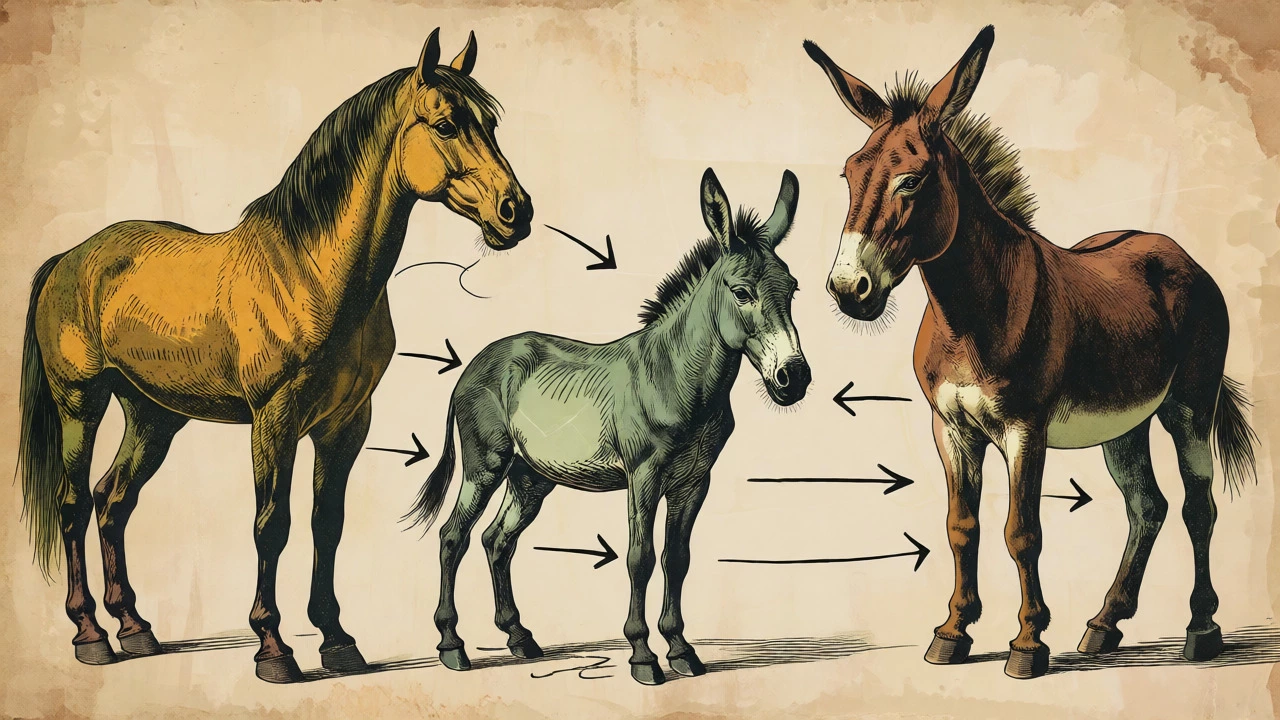
To really understand why "donkeys" is the correct plural, it helps to know what a donkey actually is. A donkey (Equus africanus asinus) is a domesticated member of the horse family, Equidae. They are distinct from horses (Equus ferus caballus) and zebras.
People often mix them up, especially when talking about hybrids. This is where the terminology gets specific, and getting it wrong can make you sound like you’ve never stepped foot on a farm.
| Animal | Singular Term | Plural Term | Parentage |
|---|---|---|---|
| Donkey | Donkey | Donkeys | Two donkeys |
| Horse | Horse | Horses | Two horses |
| Mule | Mule | Mules | Male donkey + Female horse |
| Hinny | Hinny | Hinnies | Male horse + Female donkey |
| Foal | Foal | Foals | Young donkey, horse, or zebra |
Notice anything about "hinny"? That one ends in a consonant + y (n+y). So, following our rule, it becomes "hinnies." But "mule" ends in 'e', so it’s just "mules." "Donkey" has that vowel buffer ('e'), so it stays "donkeys." See how the spelling dictates the grammar? It’s all about those final letters.
Historical Context: From Ass to Donkey
For centuries, the word "ass" was the standard term for these animals. You’ll see it in older literature, including the Bible and Shakespeare. "Ass" comes from the Latin "asinus." Over time, however, "ass" started picking up negative connotations in British English, largely due to rhyming slang and general vulgarity creeping into everyday speech.
Enter "donkey." Most etymologists trace its origin to the late 18th century in Britain. One popular theory suggests it came from the name "Don" or "Donald," possibly referring to a stubborn character. Another theory links it to the word "dun," meaning grayish-brown, describing the common coat color of many donkeys.
By the mid-19th century, "donkey" had largely replaced "ass" in polite conversation. This shift wasn’t just about politeness; it was also practical. As farming became more industrialized, clearer terminology helped avoid confusion between the animal and other meanings of "ass." Since "donkey" was a new word entering the lexicon, it didn’t carry any old irregular plural baggage. It just followed the dominant trend of adding 's' to most nouns. That’s why we say "donkeys" today instead of some hypothetical "donkine" or "doncien."