
Mirror Type Selector
Find Your Perfect Mirror
Describe your situation and we'll recommend the ideal mirror type based on real-world applications from physics principles.
Ever look into a mirror and wonder why some make you look taller, others wider, or just show a normal reflection? Not all mirrors are the same. The shape of the glass and the way it’s curved changes everything - from how you see yourself to how light behaves in a room. There are only three main types of mirrors you’ll ever need to know: plane, concave, and convex. Each one works differently, and each has real-world uses you’ve probably seen without even realizing it.
Plane Mirrors: The Everyday Standard
The most common mirror you’ve ever used is a plane mirror. It’s flat. Simple. No curves. You find these in bathrooms, bedrooms, and dressing rooms. When you look into one, your reflection looks exactly like you - same size, same distance, no distortion. That’s because plane mirrors reflect light at the same angle it hits them. This is called the law of reflection: the angle of incidence equals the angle of reflection.
Why does this matter? Because plane mirrors create virtual images. That means the image appears behind the mirror, but there’s no actual light there. It’s just your eyes tricking you. That’s why you can’t project a plane mirror’s image onto a wall - it doesn’t exist in physical space. But for daily use, it’s perfect. It gives you an accurate, life-sized view. That’s why dentists use them to see the back of your teeth, and why security mirrors in stores are flat - they show exactly what’s happening without warping the view.
Concave Mirrors: Focusing the Light
Now imagine a mirror that curves inward, like the inside of a spoon. That’s a concave mirror. It’s curved toward the viewer, and it does something strange: it focuses light. When parallel rays of light hit a concave mirror, they bounce and meet at a single point called the focal point. This is why these mirrors are used in telescopes, satellite dishes, and even car headlights.
In a car headlight, the bulb sits right at the focal point of a concave mirror. The light bounces off the curved surface and shoots out in a strong, straight beam. That’s how you see the road ahead at night. In makeup or shaving mirrors, concave mirrors magnify your face. The closer you are to the mirror, the bigger and clearer your reflection becomes. But if you step back too far, the image flips upside down. That’s because concave mirrors can create both magnified and inverted images depending on distance.
They’re also used in solar cookers. The curved surface concentrates sunlight onto a small area, heating food without electricity. In hospitals, dentists use small concave mirrors to focus light into hard-to-see areas of the mouth. This type of mirror doesn’t just reflect - it directs and amplifies.

Convex Mirrors: The Wide-Angle View
Think of a mirror that bulges outward, like the back of a spoon. That’s a convex mirror. It curves away from the viewer, and it does the opposite of a concave mirror: it spreads light out. Instead of focusing, it widens the field of view. That’s why you see these on the side of cars - they show you more of what’s behind you than a flat mirror ever could.
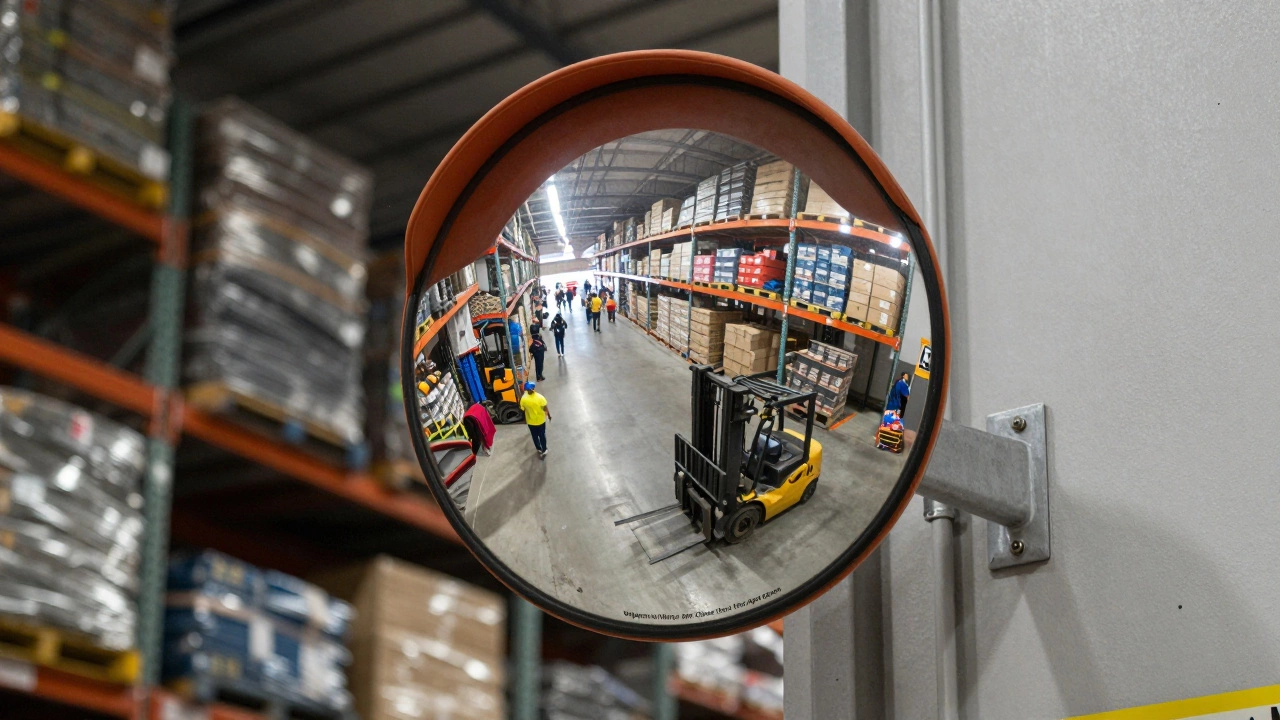
Because convex mirrors spread light, they make things look smaller and farther away than they really are. That’s why signs near these mirrors say, “Objects in mirror are closer than they appear.” It’s not a trick - it’s physics. The mirror’s curve bends light so much that your brain misjudges the distance. But that’s the point. In parking lots, warehouses, and busy intersections, convex mirrors give drivers and workers a much wider view. They reduce blind spots. In retail stores, they help employees monitor aisles without turning around.
They’re also used in ATMs, elevators, and even some security systems. The wider view helps prevent accidents and theft. Unlike plane or concave mirrors, convex mirrors always create upright, reduced images. No matter how close or far you are, you’ll never see an upside-down reflection. That’s why they’re the go-to choice when you need safety and coverage, not detail.
Why Knowing the Difference Matters
Choosing the right mirror isn’t just about looks - it’s about function. If you’re installing a mirror in your bathroom, a plane mirror gives you the clearest view. If you want to see your whole face up close while applying makeup, a small concave mirror helps. If you’re worried about blind spots in your garage or driveway, a convex mirror gives you the wide-angle view you need.
Even in home decor, the type of mirror changes the feel of a room. A large plane mirror can make a small space feel bigger. A concave mirror adds a modern, high-tech vibe. A convex mirror, often used as a decorative accent, brings a retro, fun look. Knowing how each type behaves helps you pick the one that actually works for your space - not just the one that looks nice.
Real-World Examples You’ve Seen
- Plane mirror: Your bathroom mirror, hallway mirror, dressing room mirror
- Concave mirror: Car headlights, dentist’s headlamp, makeup mirror, telescope mirrors
- Convex mirror: Car side mirrors, security mirrors in stores, blind spot mirrors on trucks, elevator mirrors
You don’t need to be a physicist to use these mirrors. But understanding how they work helps you choose the right one - whether you’re fixing a car, decorating a room, or just trying to see your reflection clearly.
Can a mirror be more than one type at once?
No. A mirror’s shape determines its type. A flat mirror is always a plane mirror. A mirror that curves inward is concave. One that curves outward is convex. You can’t combine them into one surface and still call it a single type. But you can have multiple mirrors in one setup - like a vanity with a flat center mirror and convex side mirrors for wider views.
Why do some mirrors make me look taller or fatter?
That’s not the mirror itself - it’s the curve. A concave mirror can make you look taller if you’re standing close to it because it magnifies vertically. A convex mirror can make you look wider because it stretches the image horizontally to fit more into the view. Some mirrors in stores or dressing rooms are intentionally curved to flatter or distort - it’s a design choice, not a defect.
Are all bathroom mirrors plane mirrors?
Most are, yes. But some high-end bathroom mirrors have built-in concave sections for makeup or shaving. These are labeled as “magnifying mirrors” and usually have a switch or a toggle to flip between flat and magnified views. The main surface is still a plane mirror - the magnifying part is a small concave inset.
Can convex mirrors be used indoors?
Absolutely. Convex mirrors are great indoors for safety and visibility. They’re commonly used in hallways, corners of rooms, near staircases, and in warehouses to help people see around blind turns. Decorative convex mirrors with ornate frames are also popular in modern homes for their retro look.
Do mirrors wear out over time?
The glass itself doesn’t wear out, but the reflective coating on the back can. Over time, moisture, cleaning chemicals, or poor installation can cause the silver or aluminum layer to peel or tarnish. This is especially common in humid areas like bathrooms. If you notice spots, fogging, or dark patches, the coating is failing. Replacing the mirror is usually cheaper than trying to fix it.