Infinity Mirror Simulator
Explore how mirror alignment and quality affect the "infinite" tunnel effect. Adjust the settings below to see how many images appear and how quickly they fade.
Even with perfect alignment, no mirror reflects 100% of light. At 85% reflectivity, after just 10 bounces, less than 20% of the original light remains. Your eyes stop detecting the image when it falls below a certain brightness threshold.
You have probably seen those trippy photos on Instagram where someone stands between two facing mirrors and seems to vanish into an endless tunnel of themselves. It looks like magic, but it is actually just physics doing its thing. So, what happens if you put a mirror in front of a mirror? The short answer is: you create an infinite mirror effect. But the real story is about how light bounces back and forth, why the images get darker as they go deeper, and how you can control this visual trick in your own home.
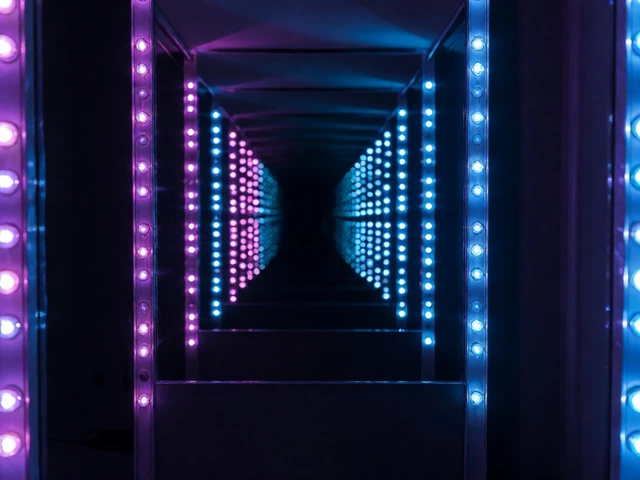
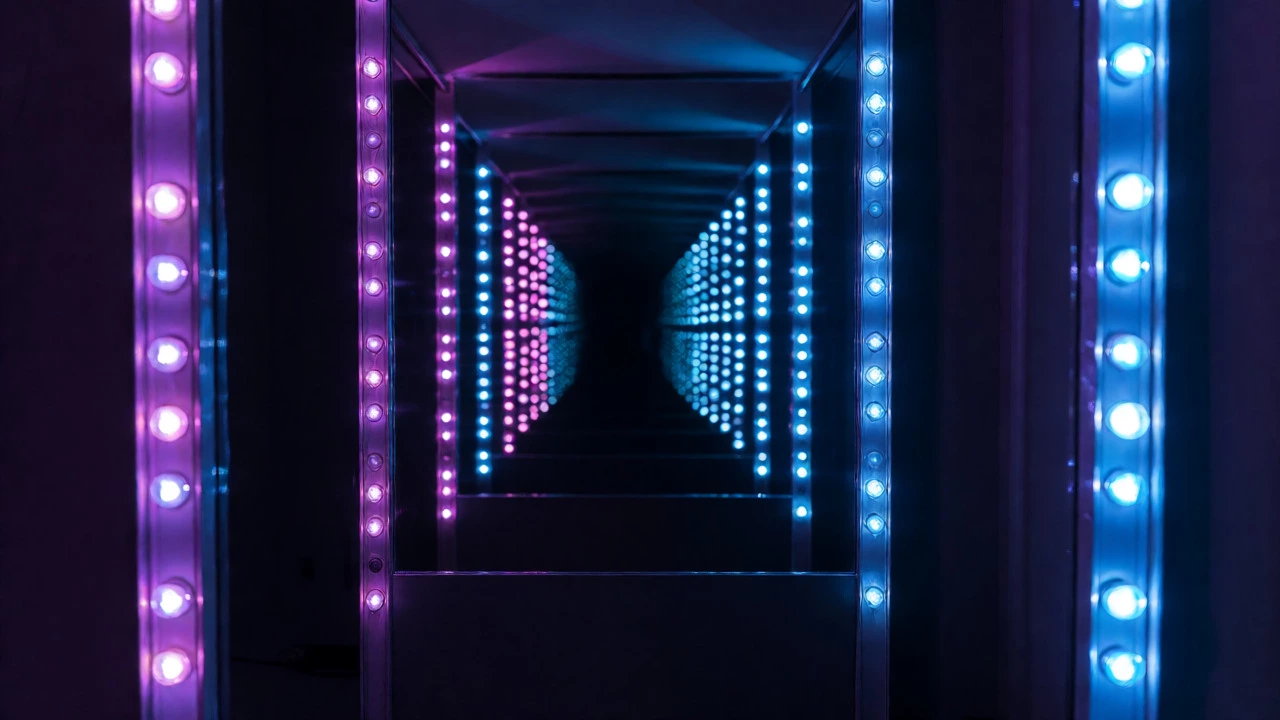
The phenomenon occurs when two reflective surfaces face each other directly. Each mirror reflects the image from the other mirror, which then reflects that new image, and so on. This creates a series of repeated images that appear to recede into the distance forever. In optics, this is known as multiple reflection. While true infinity is impossible because mirrors aren't perfect, the human eye perceives it as an endless corridor until the light becomes too dim to see.
The Physics Behind the Endless Tunnel
To understand why this works, you need to think about light as a ball bouncing between two walls. When you stand in front of a single mirror, light travels from you to the glass and bounces straight back to your eyes. That is one bounce. Now, place a second mirror behind you, facing the first one. Light hits the first mirror, bounces to the second mirror, bounces back to the first mirror, and finally reaches your eyes. That is three bounces for the first "deep" reflection.
Every time the light bounces, it loses a tiny bit of energy. No mirror is 100% efficient. Most household mirrors reflect about 85% to 90% of visible light. The rest is absorbed by the silver or aluminum coating or lost through the glass. Because of this absorption, each subsequent reflection gets slightly dimmer and less sharp. After dozens of bounces, the image fades into blackness. That is why the "infinity" has a limit-it ends when the light is too weak for your retina to detect.
Why Distance Matters More Than Size
A common misconception is that bigger mirrors make the infinite effect stronger. They don't. The depth of the tunnel depends entirely on the distance between the two mirrors. The wider the gap, the more space there is for the reflections to spread out visually. If you push two small hand mirrors close together, you still get the infinite effect, but the tunnel looks compressed. Pull them apart, and the tunnel stretches.
There is also a practical limit to how far apart you can place them. If the mirrors are too far away, the angle of view becomes critical. You have to position your head perfectly in the center to see the full sequence. Move your head even a few centimeters to the left, and the reflections shift. This sensitivity makes wide setups tricky for casual viewing but perfect for artistic installations where the viewer moves around.
Angled Mirrors: Breaking the Loop
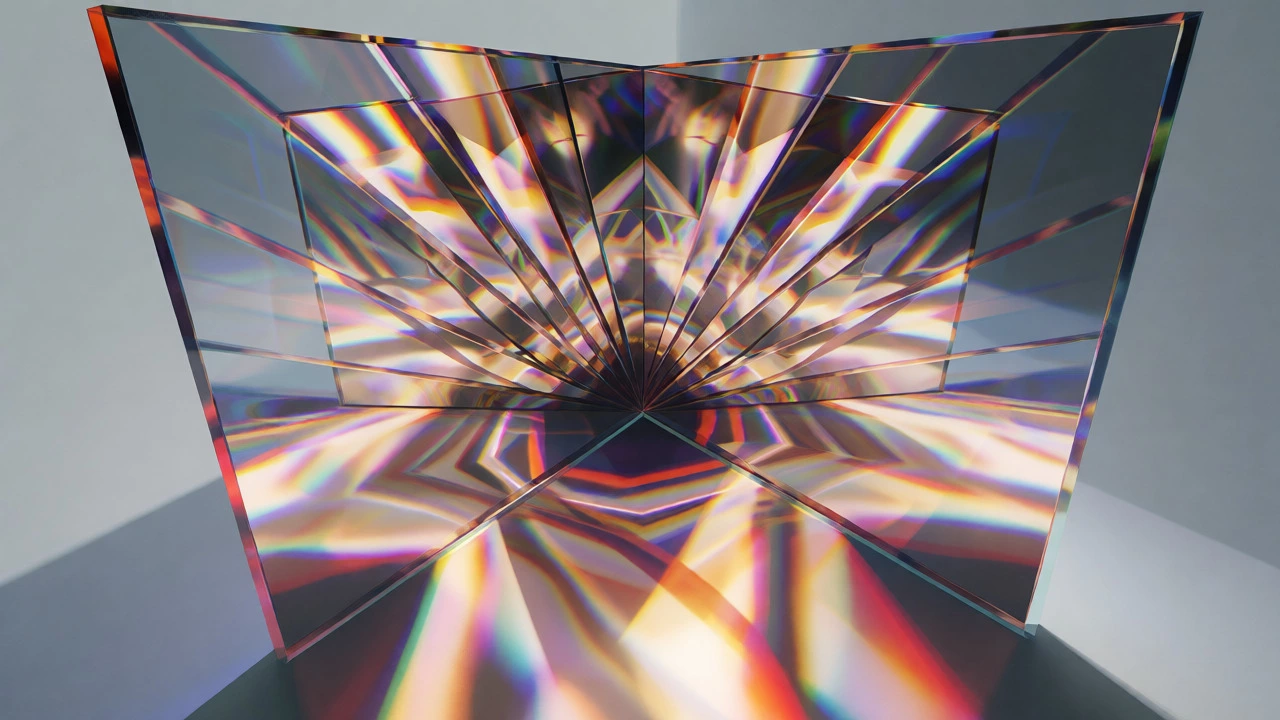
Facing mirrors head-on is just one way to play with reflections. What if you tilt them? When you change the angle between two mirrors, you break the linear tunnel and create geometric patterns instead. This is the principle behind kaleidoscopes.
If you set two mirrors at a 90-degree angle (like the corner of a room), you will see four distinct images of yourself. Why four? The math is simple: divide 360 degrees by the angle between the mirrors, then subtract one. For 90 degrees: $360 / 90 - 1 = 3$ additional images plus the original, totaling four. At 60 degrees, you get five images. At 45 degrees, seven. As the angle gets smaller, the number of reflections increases exponentially. This isn't infinite anymore; it's a finite, symmetrical pattern. Artists use this technique to turn simple objects into complex, mandala-like designs.
Creating Your Own Infinity Room
You do not need a museum budget to try this at home. An Infinity Room, popularized by artist Yayoi Kusama, is essentially a large-scale version of the double-mirror trick. You can build a mini version using materials from any hardware store.
- Two identical flat mirrors: Ensure they are clean and free of scratches. Scratches disrupt the clarity of deep reflections.
- LED strip lights: Place these along the edges of one mirror. The lights themselves will be reflected infinitely, creating a glowing tunnel effect.
- Spacer material: Use foam board or wooden strips to keep the mirrors parallel and at a fixed distance.
- Black paint: Paint the non-reflective side of the frame or the surrounding area matte black. This absorbs stray light and enhances the contrast, making the reflections pop.
Assembly is straightforward. Mount one mirror vertically. Attach the LED strip to its edge. Place the second mirror parallel to the first, leaving a gap of about 10-20 cm. Plug in the lights. Stand back and look through the gap. You should see a bright, repeating column of light stretching into darkness.
Troubleshooting Common Issues
If your setup doesn't look like the photos online, check these three things. First, alignment. Even a slight tilt means the reflections drift sideways and disappear off the edge of the mirror. Use a laser level to ensure both mirrors are perfectly vertical and parallel to each other.
Second, cleanliness. Dust spots become glaringly obvious in the third or fourth reflection. A fingerprint on the front mirror appears as a smudge in every subsequent image. Clean both surfaces thoroughly before starting.
Third, lighting conditions. Ambient light ruins the effect. If your room is brightly lit, the background reflections wash out. Dim the main lights and rely solely on the LEDs inside the mirror box. The darker the environment, the deeper the perceived infinity.
Real-World Applications Beyond Decoration
This isn't just a party trick. Engineers use parallel mirrors in lasers. A laser cavity consists of two mirrors facing each other, trapping photons and amplifying the light beam with each pass. Without this precise mirror alignment, modern fiber-optic internet wouldn't work efficiently.
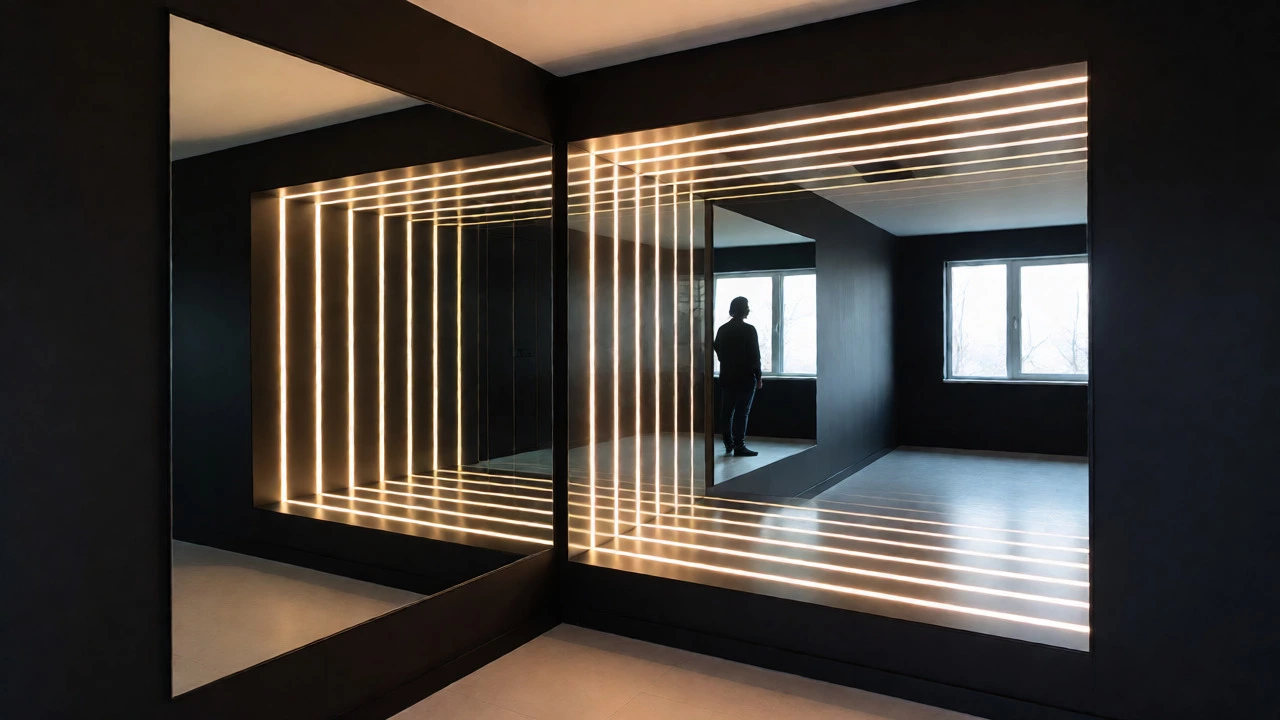
In interior design, architects use angled mirror placements to expand small spaces. By placing a mirror opposite a window, they double the amount of natural light entering a room. Placing two mirrors adjacent to each other at an angle can create the illusion of a larger floor plan without adding square footage. It is a cheap hack for renters who cannot knock down walls.
Comparison: Parallel vs. Angled Mirrors
| Alignment Type | Visual Effect | Number of Images | Best Use Case |
|---|---|---|---|
| Parallel (0° difference) | Infinite tunnel receding into darkness | Theoretically infinite (limited by light loss) | Art installations, jewelry displays |
| Perpendicular (90° angle) | Symmetrical quadrant pattern | 4 total images | Bathroom corners, compact rooms |
| Acute Angle (e.g., 45°) | Kaleidoscopic fan shape | 7 total images | Decorative accents, children's rooms |
| Oblique Angle | Distorted, elongated reflections | Variable | Modern art, dynamic spaces |
Frequently Asked Questions
Does the infinite reflection ever truly stop?
Yes, it stops due to light absorption. Since no mirror reflects 100% of light, the intensity decreases with each bounce. Eventually, the light is too dim for the human eye to perceive, effectively ending the sequence after 50 to 100 reflections depending on mirror quality.
Why do the reflections get darker?
Each reflection involves light hitting the mirror surface, where some energy is absorbed by the metal coating and glass substrate. With every bounce, a percentage of the remaining light is lost, causing the image brightness to decay exponentially.
Can I use curved mirrors for the infinite effect?
You can, but the result changes. Curved mirrors distort the path of light. Instead of a straight tunnel, you might see swirling or warped patterns. Concave mirrors can focus light, potentially making reflections brighter initially, while convex mirrors scatter them, reducing the depth of field.
How far apart should the mirrors be?
For a standard infinity mirror box, 5 to 15 centimeters is ideal. This allows enough space for LED strips and creates a clear separation between reflections. Larger distances require precise alignment tools to maintain the parallel effect across the entire surface.
Do smart mirrors affect this phenomenon?
Smart mirrors often have semi-transparent screens over the reflective layer. This reduces reflectivity significantly compared to traditional silvered glass. You will see fewer deep reflections, and the digital display may interfere with the continuity of the infinite tunnel unless the screen is turned off.