Closet Depth Calculator & Visualizer
Enter your closet dimensions to see if it complies with standard hanging requirements.
Input Measurements
Analysis Result
Click "Analyze Fit" to see results.
You open your closet door, and your jacket sleeves are sticking out. The hangers won't close. You feel like you're fighting a losing battle against your own clothes before you've even left the house. This isn't just bad luck or a messy habit-it's usually a math problem. Specifically, it's a violation of what designers call the 18 inch storage rule. It sounds technical, but it’s actually one of the simplest guidelines in home organization: if you want to hang clothes comfortably without them crushing against the back wall or preventing the door from closing, your closet needs to be at least 18 inches deep.
Why 18 inches? Because that is the average depth of a standard adult shoulder plus the width of a hanger. If you go smaller, you’re forcing physics to bend to your will, and physics rarely loses gracefully. But this rule isn’t just about jackets. It applies to shelves, shoe racks, and even how you stack boxes. Understanding this measurement can save you from buying furniture that doesn’t fit or designing a walk-in closet that feels cramped despite being spacious.
The Physics Behind the Measurement
Let’s break down where this number comes from. It’s not arbitrary. Standard wooden or plastic hangers are typically 17 to 18 inches wide. When you hang a shirt, the shoulders extend slightly beyond the hanger arms. Add in the thickness of the fabric and the fact that clothes aren’t perfectly flat objects-they have volume-and you quickly exceed 16 inches. Most ready-to-wear clothing is designed for an average human body, which has an average shoulder breadth. Designers use 18 inches as the safe baseline because it accounts for bulky winter coats, blazers with structured shoulders, and the natural puffiness of puffer jackets.
If you try to squeeze these items into a 15-inch deep closet, two things happen. First, the doors won’t shut properly unless you angle the hangers, which looks chaotic and wastes vertical space. Second, the clothes get crushed. Fabric creases permanently, especially on delicate materials like silk or wool blends. Over time, this damages the garment’s shape. The 18-inch rule ensures there is enough clearance between the front of the clothing and the back wall, allowing air circulation and preventing friction damage.
| Item Type | Minimum Depth Needed | Recommended Depth | Why? |
|---|---|---|---|
| T-Shirts & Blouses | 14 inches | 16-18 inches | Lightweight, less bulk, but still need hanger clearance. |
| Dress Shirts & Pants | 16 inches | 18 inches | Pants require full drop length; shirts have collars/stiffness. |
| Suits & Blazers | 18 inches | 20+ inches | Structured shoulders add significant depth. |
| Winter Coats | 18 inches | 22+ inches | Bulkiness varies wildly; down jackets expand significantly. |
| Shoes (Heeled) | 12 inches | 14-16 inches | Heels stick out; toe box adds length. |
Applying the Rule to Hanging Spaces
When you are planning a new closet or renovating an old one, measure the existing depth before you buy any organizers. If your current closet is only 12 or 13 inches deep-common in older apartments or reach-in closets-you cannot follow the 18-inch rule for long garments. You have three options here. First, you can install shallow hangers. These are specialized hangers with a lower profile that reduce the overall depth footprint. They work well for t-shirts and light blouses but fail miserably with heavy coats.
Second, you can switch to front-facing display. Instead of hanging clothes side-by-side, you hang them facing forward using hooks or special rails. This changes the geometry entirely. Now, the depth requirement drops to about 4-6 inches because the clothes are parallel to the wall. This is great for boutiques or small entryways but requires more horizontal space. Third, you accept the compromise. You hang shorter items like shirts and pants, and store coats elsewhere. Trying to force a suit jacket into a 12-inch closet is a recipe for wrinkled misery.
For walk-in closets, you have more freedom. Here, you should aim for 24 inches if possible. Why go deeper than 18? Because 24 inches allows you to double-hang rods or create a second row of hanging space behind the first. It also gives you room to step inside and browse without feeling claustrophobic. Remember, the 18-inch rule is the minimum viable product for hanging clothes. Anything less compromises functionality.

Shelves and Stacking: Where Depth Matters Too
The 18-inch rule isn’t limited to hangers. It applies heavily to shelving units. Think about folded sweaters, jeans, or stacks of towels. A standard folded sweater is roughly 12-14 inches deep when placed on a shelf. If your shelf is only 12 inches deep, the sweater hangs over the edge. This looks untidy and makes it hard to pull items off without disturbing the rest of the stack. Worse, dust accumulates on the exposed parts.
For general storage shelves, 12 to 14 inches is often sufficient for books, linens, and folded casual wear. However, if you plan to store larger items like handbags, shoe boxes, or decorative bins, you need to check their dimensions. Many standard shoe boxes are 13-14 inches deep. If your shelf is 12 inches, the box sticks out. If you use wire baskets, remember that they bulge outward. Always measure the widest part of the container, not just the base.
A common mistake is assuming that "deep" means "better." Going too deep creates dead zones. If your shelf is 24 inches deep and you place a small basket at the front, everything behind it becomes invisible and inaccessible. This is known as the "out of sight, out of mind" trap. For shelves, the sweet spot is usually 12-16 inches. This allows you to see and reach everything easily. Use the 18-inch rule specifically for hanging zones, and adjust downward for static storage.
Common Pitfalls and How to Fix Them
One major pitfall is ignoring the hardware. A standard closet rod protrudes about 1.5 to 2 inches from the back wall. So, if your closet cavity is exactly 18 inches, your usable hanging space is effectively 16 inches. You’ve already violated the rule before you hang a single shirt. To fix this, either build the closet 20 inches deep to account for the rod, or mount the rod flush against the back panel if possible. Some modern systems allow for recessed mounting, which reclaims those precious inches.
Another issue is door swing. Sliding doors save space but often come with tracks that eat up 1-2 inches of depth at the bottom or top. Bi-fold doors are notorious for requiring extra clearance. If you have bi-folds, ensure the hinge mechanism doesn’t interfere with the longest garment. Test it with a coat before finalizing your layout. If you find yourself constantly pushing clothes aside to close the door, you need to reduce the load or increase the depth.
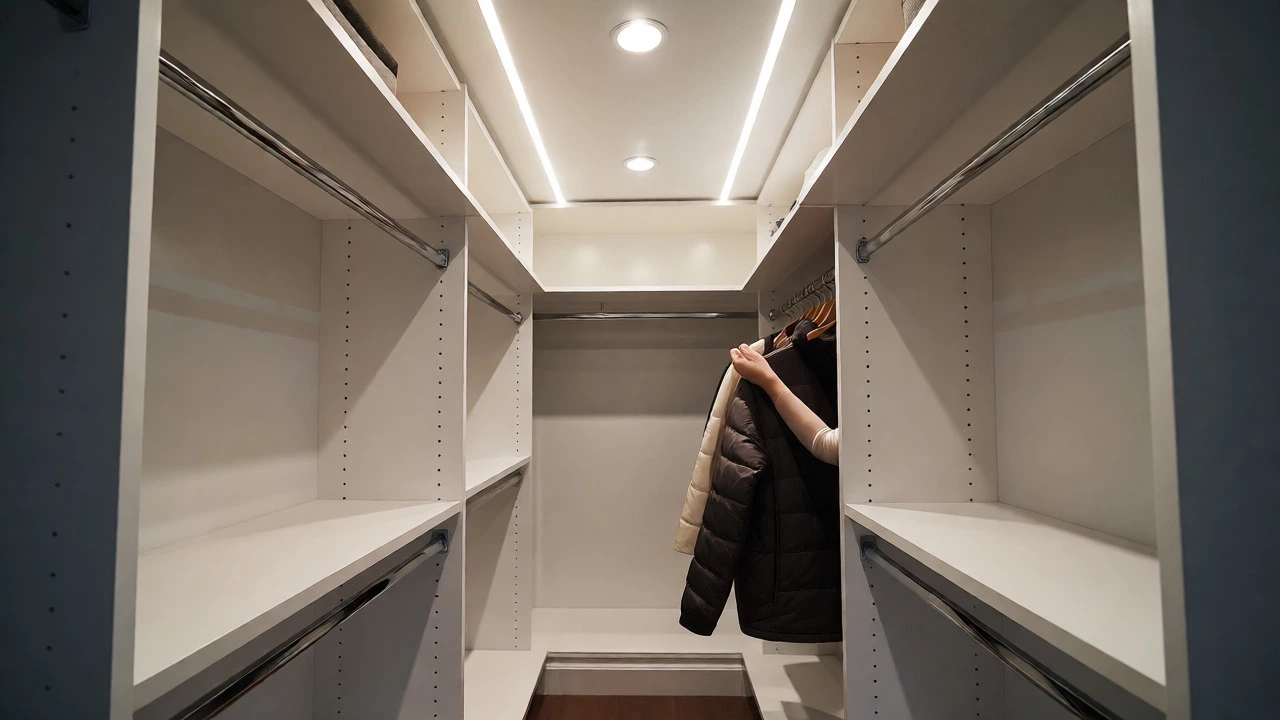
Finally, consider lighting. Deep closets are dark. If you’re digging through shadows to find a matching scarf, you’ll likely leave things disorganized simply because it’s annoying to sort. Install LED strip lights along the top of the hanging rail or under shelves. Good visibility encourages better organization, making the most of whatever depth you have.
Quick Checklist for Your Next Closet Project
- Measure Existing Depth: Check from the back wall to the inner face of the door frame. Note obstructions like rods or handles.
- Categorize Clothing: Separate items by type (coats vs. shirts). Coats need the full 18+ inches; shirts might survive on less.
- Select Appropriate Hangers: Use slim velvet hangers to maximize capacity, but ensure they don’t slip off thin straps. Avoid bulky plastic hangers in tight spaces.
- Plan Shelf Depths: Keep general shelves at 12-14 inches. Reserve deeper shelves (18+ inches) for large bins or shoe displays.
- Account for Hardware: Subtract 2 inches from total cavity depth for rod brackets and door tracks.
- Test Before Committing: Hang a few bulky items and try to close the door. If it sticks, adjust immediately.
Frequently Asked Questions
Is 18 inches enough for all types of coats?
No, 18 inches is the minimum for standard coats. Bulky down parkas, oversized trench coats, or suits with padded shoulders may require 20 to 22 inches of depth. If you have many such items, consider installing a deeper closet section or using a dedicated coat rack outside the main closet.
Can I use the 18 inch rule for children's clothes?
Children’s clothes are smaller, so you can get away with shallower depths. For toddlers, 12-14 inches is often sufficient. However, if you plan to hang school uniforms or winter jackets, stick closer to 16-18 inches to accommodate future growth and seasonal outerwear.
What if my closet is only 12 inches deep?
You have limited options. Use front-facing hooks instead of side-hanging rods. Alternatively, fold most clothes and use drawers or bins. If you must hang clothes, choose lightweight fabrics and avoid bulky items. Consider adding a freestanding garment rack in the bedroom for coats.
Does the 18 inch rule apply to sliding doors?
Yes, but you must account for the track mechanism. Sliding doors often sit within a pocket or overlap, reducing usable depth. Measure from the back wall to the closest point of the door when fully closed. Ensure your clothes clear this point by at least half an inch to prevent snagging.
How do I maximize space in a shallow closet?
Use slim hangers, double-stack rods for short items, and utilize door-mounted organizers for shoes and accessories. Fold bulky sweaters instead of hanging them. Install bright lighting to make the space feel larger and easier to navigate.